Hani Alomari
Ph.D. candidate in Computer Science, Virginia Tech
I'm a Ph.D. candidate at Virginia Tech, advised by Chris Thomas, and an Amazon Fellow for 2026–27. I work on multimodal machine learning, mostly on models that connect images and video with language. Two questions come up again and again in my work: what a model should do when an input has more than one valid interpretation, and how we can tell whether a good benchmark score reflects real understanding or a shortcut.
I did my B.S. and M.S. at Jordan University of Science and Technology, and spent summer 2026 at Adobe working on image-quality evaluation. My papers have appeared at CVPR, ACL, EMNLP, ECCV, and NeurIPS.
hani@vt.edu · CV · Google Scholar · GitHub · LinkedIn





News
- Submitted new work to ICLR 2027 and ACL Rolling Review.
- Three papers accepted to EMNLP 2026. Our length-bias paper was one of 22 selected for SAC Highlights.
- Named an Amazon Fellow through the Amazon–Virginia Tech Initiative.
- Finished my internship at Adobe in San Jose.
- Part-level visual grounding paper accepted to ECCV 2026.
Older news
- Presented Lenses at CVPR 2026 in Denver.
- Passed my Ph.D. preliminary examination.
- Lenses accepted to CVPR 2026.
- MaxMatch accepted to ACL 2025.
Research
Retrieval with multiple interpretations
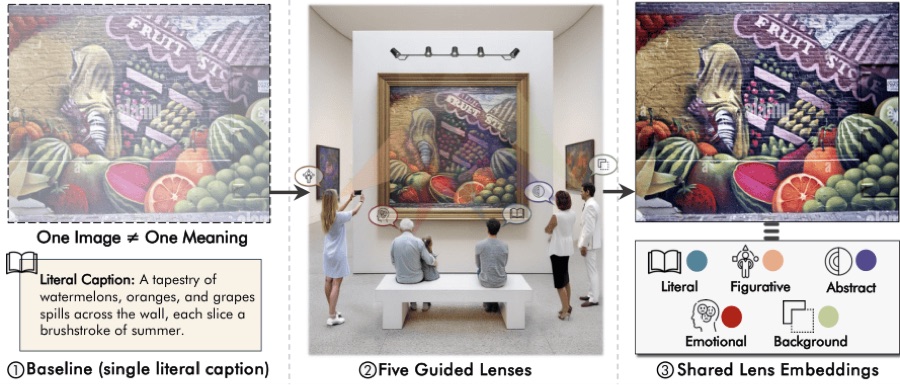
Most image–text retrieval models give each image and caption a single embedding, which forces one reading of the image. In practice the same picture can be described literally, figuratively, or by the feeling it gives. I work on models that keep several interpretations side by side, and on benchmarks that measure whether a model can match non-literal descriptions. I'm currently working on composed retrieval, where a search describes how the result should differ from an image you already have.
Reliability of vision–language models
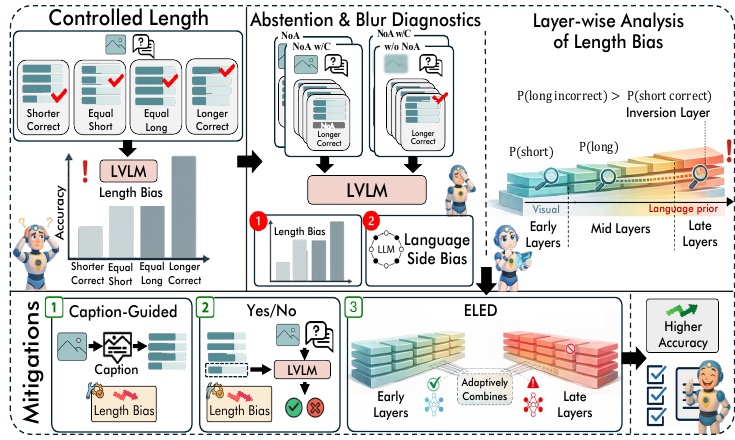
With Md Atabuzzaman and Ali Asgarov, I study the shortcuts that make vision–language models look better than they are. In multiple-choice questions, for example, models tend to pick the longest answer, and accuracy can shift by up to 38 points depending only on answer length. We also look at typos in search queries and at how models misjudge the duration of events in video, and at which fixes actually help.
Papers: Length bias in LVLMs (EMNLP 2026), JourneyBench (NeurIPS 2024); Mind the Channel and TimeCheck (under review)
Long-video and event understanding
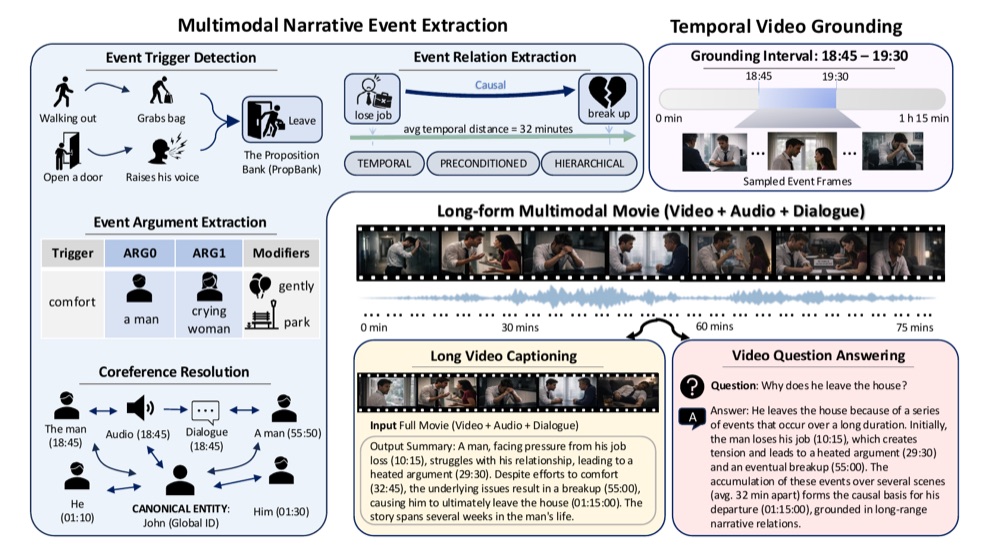
Many questions about a video can only be answered by combining several moments, such as what led to an event or what followed it. I work on benchmarks and models for how events connect across long videos, from full-length movies to news covered in text, video, and audio together.
Papers: NEST (EMNLP 2026), M³EC (EMNLP 2026), ENTER (NeurIPS 2024 workshop)
Acoustic perception
Cameras struggle in smoke, dust, and darkness, but sound still carries information about a room. With Alaa Algargoosh, I work on agents that map rooms from echoes alone, deciding where to move and when to listen. So far this is in simulation; the next step is a real robot.
Papers: EchoBelief (under review)